
 Denmark: Copenhagen’s Cycling Infrastructure
What if a city could make the car feel like the inconvenient option?
On a weekday morning in Copenhagen, the streets begin to move. Bicycles stream through junctions, along dedicated lanes and across bridges, carrying commuters to offices, children to school and parents with toddlers tucked into cargo bikes. People cycle in work clothes, carrying bags, balancing coffee cups and heading wherever they need to go.
For many of them, cycling isn’t a statement about sustainability. It is simply how they get around.
Copenhagen has spent decades making the bicycle a practical part of everyday transport, rather than treating it as a recreational activity or an alternative for the particularly environmentally conscious. The result is a city where cycling is woven into the ordinary rhythm of urban life.
There are now more than 380 kilometres of cycle tracks in Copenhagen, alongside cycling and pedestrian bridges, green routes and longer-distance cycling connections linking the city with surrounding communities (City of Copenhagen, 2026, Cycling Infrastructure). To put that into perspective, 380 kilometres is roughly the distance from London to Paris — an extraordinary amount of cycling infrastructure for a city of Copenhagen’s size.
The interesting part isn’t simply how many bicycles Copenhagen has.
It is the amount of thought that has gone into making them useful.
What has been implemented?
Start with the roads themselves.
On many of Copenhagen’s busiest streets, cyclists have dedicated tracks separated from motor traffic. At intersections, cycle routes are designed into the wider road system rather than disappearing just when a journey becomes complicated. Bridges allow cyclists and pedestrians to cross parts of the city without following the same routes as cars.
Then there are the cycle superhighways — longer, connected routes designed for people travelling into Copenhagen from surrounding areas. The idea is to make cycling a genuine option for commuting, not just for short journeys in the city centre. The network now connects 27 regions and is being developed around routes of up to approximately 20 kilometres (City of Copenhagen, 2026, Cycling Infrastructure).
The city has also introduced cycle streets, where bicycles are given priority and cars must adapt to the pace of cyclists. On busier routes, wider cycle tracks allow people to overtake more comfortably, while links with trains and the metro make it possible to combine cycling with public transport.
Taken together, these aren’t simply cycle lanes added to existing roads. They form a network designed to make cycling practical, safe and convenient.
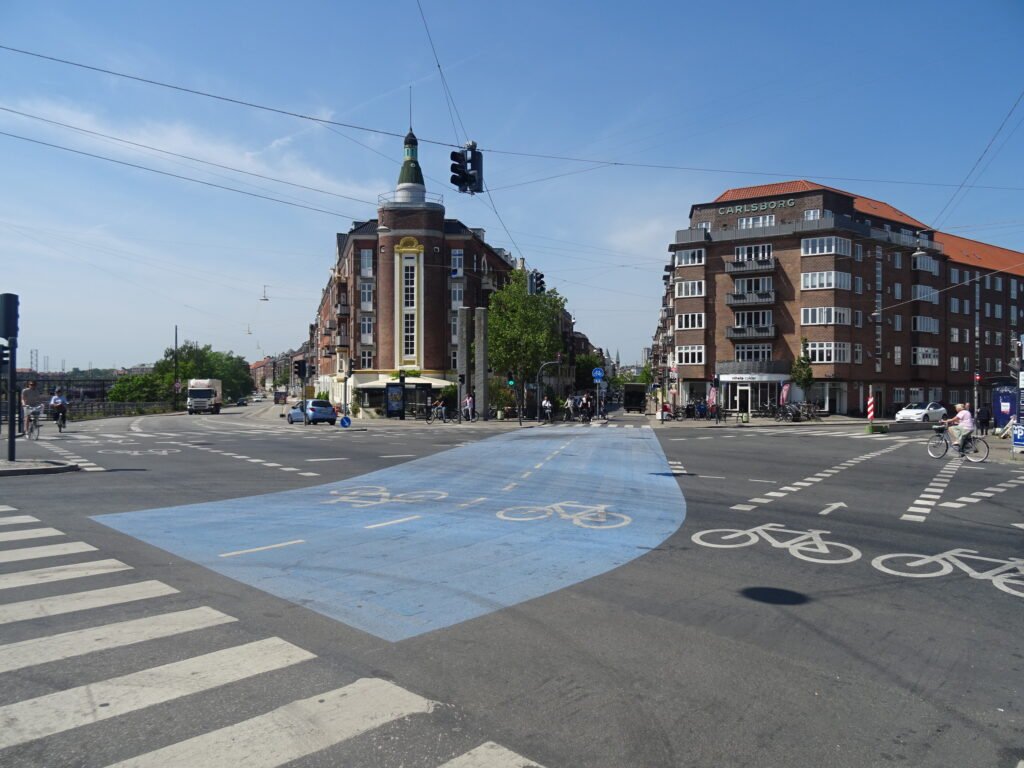 Copenhagen cycling infrastructure, Denmark. Photo: Leif Jørgensen / Wikimedia Commons, CC BY-SA 4.0.
Why does it matter?
Transport is one of the most stubborn problems in the sustainability conversation. Asking people to drive less sounds simple until you consider what driving provides: it is convenient, familiar and often deeply embedded in how cities are built.
Copenhagen’s approach tackles that problem from another direction.
Rather than relying entirely on individual choices, it changes the choices available.
A protected cycle track can make a nervous cyclist feel safer. A bridge can remove a long detour. A continuous route can make a 10 or 15 kilometre commute feel possible. Secure cycle parking can make arriving at work by bike less complicated. When all of those things exist together, cycling stops feeling like an effort that requires planning and starts to feel like normal transport.
The environmental benefits follow from that shift. More travels made by bicycle can mean fewer car journeys, reducing congestion and transport emissions while also contributing to cleaner air and greater physical activity. Copenhagen’s cycling strategy also connects cycling with public health and the quality of urban life (City of Copenhagen, 2026 – CPH Climate Strategy 2035).
There is a lesson here that extends well beyond Denmark: sustainable behaviour becomes considerably easier when the infrastructure supporting it already exists.
The bigger sustainability picture
Copenhagen’s cycling network is really an experiment in how we allocate space.
A road has a limited amount of room. Every metre given to a cycle track, pavement, bus lane or car lane represents a decision about what — and who — that space is for.
For decades, many cities expanded around the assumption that growing populations would mean more cars. Copenhagen has spent much of the same period investing in a different possibility: that a growing city can move more people without simply putting more vehicles onto its roads.
It isn’t a perfect model. Copenhagen still has congestion and debates over how much space should be given to different forms of transport. Cycling infrastructure also costs money to build and maintain, and the city’s relatively compact, flat geography makes the Danish experience difficult to reproduce in large, spread-out cities.
But perhaps Copenhagen’s most useful export isn’t its cycle lanes at all. It is the idea that infrastructure can shape behaviour just as much as behaviour shapes infrastructure.
If a city makes driving easy and cycling difficult, people will naturally adapt to that reality.
Change the equation, and different choices become possible.
Copenhagen hasn’t asked its residents to stop using cars and start saving the planet one bicycle ride at a time. It has spent decades making another way of moving through the city increasingly difficult to ignore.