
 Hong Kong: The City's Rubbish has a New Destination
3,000 tonnes of rubbish. Every day.
It is difficult to picture what that actually means.
Imagine roughly 200 double-decker buses filled with waste arriving each day. Now imagine doing that day after day, year after year. That is the scale of the problem Hong Kong is trying to deal with.
Hong Kong is one of the world’s most densely populated cities. Millions of people live, work, eat and shop within a relatively small area, and all of that activity leaves something behind. Food packaging. Old furniture. Takeaway containers. Broken products. Things bought on Monday and forgotten by Friday.
For most of us, rubbish has a very short story. It goes into a bin. A truck takes it away. We stop thinking about it – but the rubbish does not disappear. For years, much of Hong Kong’s municipal waste has been sent to landfill. The problem is that land is not something the city has in abundance. A landfill can be filled; once it is full, another place has to be found.
So Hong Kong has started doing something rather different. On an artificial island near Shek Kwu Chau, it has built a facility where some of the city’s rubbish is used to generate electricity (Hong Kong Environmental Protection Department, 2024).
It is called I·PARK, and it changes what happens after the bin.
What has been implemented?
So, what actually happens once that rubbish reaches I·PARK?
Inside the facility, the waste is burned at very high temperatures. The heat boils water, creating steam powerful enough to turn turbines. Those turbines then generate electricity, which can be supplied to Hong Kong’s power grid.
So, rather than the energy being lost as the waste is destroyed, some of it is captured and put to use. At full operation, I·PARK 1 is expected to generate enough surplus electricity to supply around 100,000 households for a year (Hong Kong Environmental Protection Department, 2024).
It is not, however, a case of simply burning everything that gets thrown away. Materials that can still be reused or recycled are better kept in circulation, while the emissions and ash produced during the process have to be carefully treated and controlled. I·PARK is intended for the waste that remains once those options have been considered.
I·PARK is not the beginning of Hong Kong’s approach to waste, nor is it the whole solution. It sits further down the chain, dealing with what is left after other possibilities have been exhausted.
What makes it interesting is the shift in thinking. Instead of seeing the final pile of unwanted waste as having nothing left to offer, I·PARK tries to extract one last useful thing from it: energy.
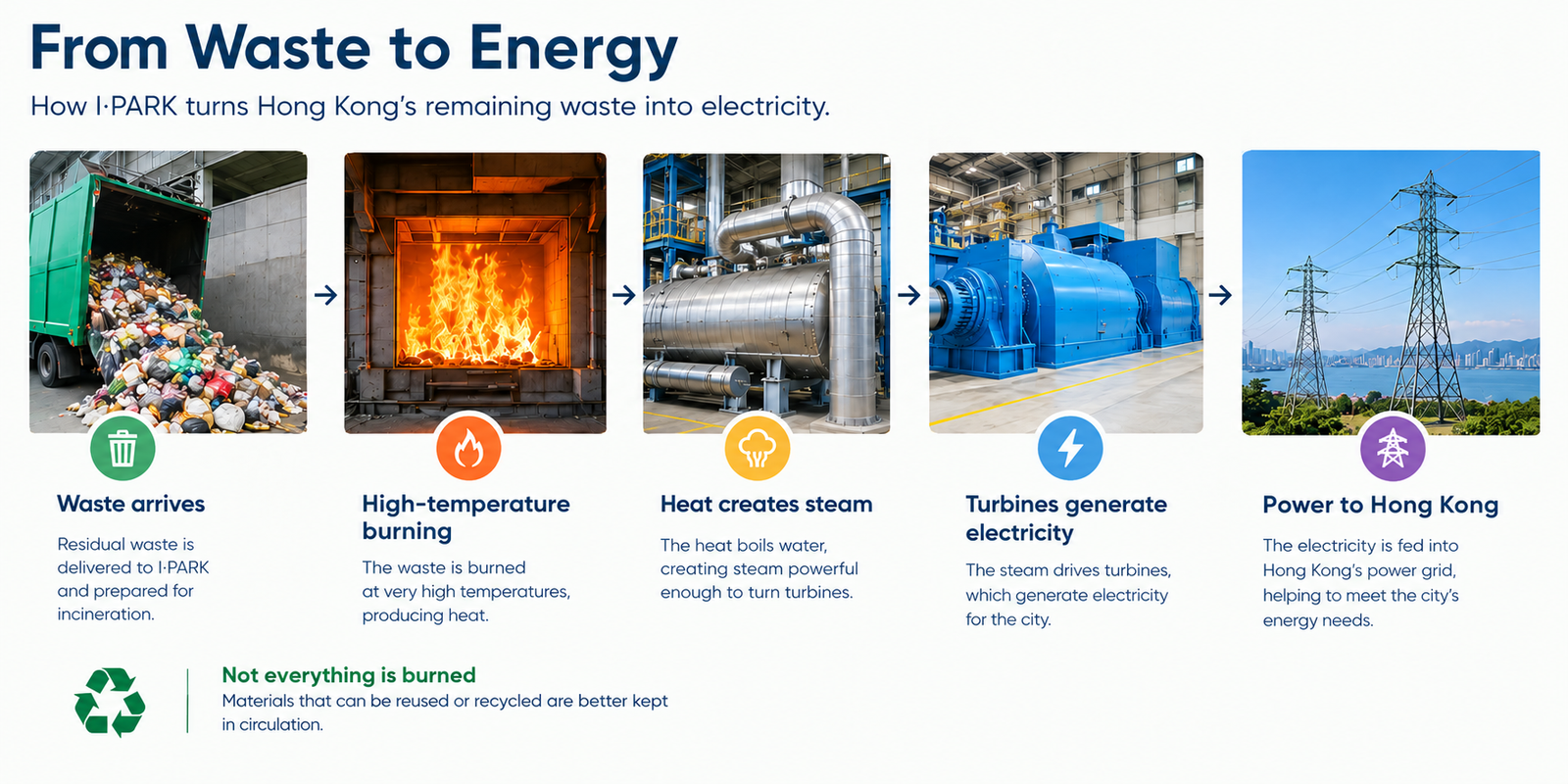 I·PARK Waste-to-Energy Process Flow Diagram. Author generated (2026).
Why does it matter?
Look at Hong Kong on a map and the problem becomes easier to understand. Mountains occupy much of the territory, the city stretches along a coastline and high-rise buildings dominate the urban landscape. Space is valuable, and rubbish needs space too.
A landfill is essentially a place where waste is given somewhere to stay, but eventually, it stays there permanently.
Hong Kong’s waste problem is also far larger than most people realise. In 2025, the city disposed of an average of around 10,326 tonnes of municipal solid waste every day. I·PARK 1’s eventual capacity of 3,000 tonnes a day would therefore be enough to handle almost three out of every ten tonnes of that waste (Hong Kong Environmental Protection Department, 2025).
That comparison reveals both the scale of the facility and the scale of the problem. I·PARK is significant, but it is not designed to solve Hong Kong’s entire waste stream on its own.
Its role is to change what happens to a substantial proportion of the waste that would otherwise end up in landfill. Through incineration, its volume can be dramatically reduced, while some of the energy contained within the waste is recovered as electricity. For a city with limited land, that combination matters.
The bigger sustainability picture
I·PARK is an impressive piece of technology, but its existence also reflects the scale of Hong Kong’s waste problem.
The cleanest piece of rubbish is still the piece of rubbish that was never produced. A waste-to-energy plant cannot undo the environmental cost of manufacturing a product, recover every raw material that went into it or make overconsumption sustainable simply by generating electricity from what is thrown away.
That is why I·PARK makes more sense as part of a wider system than as a standalone solution: reduce what you consume, reuse what you can, recycle what still has value and then find a better way to deal with the waste that remains.
There is also an important climate dimension. When organic waste decomposes in landfill, it can produce methane, a powerful greenhouse gas. By diverting waste away from landfill and recovering energy from it, Hong Kong estimates that I·PARK 1 could help avoid around 440,000 tonnes of greenhouse-gas emissions each year (Hong Kong Environmental Protection Department, 2025).
Suddenly, the enormous facility on an artificial island is connected to something much larger than rubbish. It is part of the question of how a modern city deals with the consequences of its own consumption. Hong Kong is not going to stop producing waste. No city is. The more interesting question is what happens after millions of people have finished with the things they buy.
For decades, the answer was largely to put the waste in the ground. Now, some of Hong Kong’s rubbish is taking a different route: it arrives as something unwanted, is used to produce heat and steam, and ultimately contributes electricity to the city’s grid. The rubbish has not become harmless, and I·PARK does not make waste sustainable, but it does give something that was destined to be discarded one more use.