 Fiji: The Blue Economy
Can Fiji Build an Economy Without Exhausting Its Ocean?
For Fiji, the sea is not somewhere you go when you want to escape the mainland.
It is the mainland.
Spread across more than 300 islands in the South Pacific, Fiji’s communities, businesses and livelihoods are closely tied to the ocean. Fish provide food and income. Coral reefs support tourism. Boats connect islands that roads cannot. Coastal ecosystems protect communities from storms and waves.
Fiji’s ocean territory is also vast — more than 70 times larger than its land area.
That creates an unusual sustainability challenge. The ocean is one of Fiji’s greatest economic assets, but the more heavily it is used, the greater the risk of damaging the ecosystems that make that economy possible in the first place.
Fiji is now trying to approach that problem through something called the Blue Economy: an economic model built around using marine resources sustainably, while keeping the ocean healthy for the future.
What has been implemented?
In January 2026, Fiji launched its Blue Economy Framework 2025–2035, setting out an ambitious plan for how the country will use and protect its ocean over the next decade.
The thinking behind it is relatively simple: if Fiji’s future depends so heavily on the sea, then the health of that sea needs to be built into the way the country grows.
Take fishing. For coastal communities, the ocean is a source of food and income, but there is a limit to how much can be taken from it before those same livelihoods begin to suffer. The framework therefore places greater emphasis on managing marine resources so that they can continue supporting communities long into the future.
Tourism creates a similar relationship. Visitors come to Fiji for the very things that can be damaged by poorly managed development — clear waters, coral reefs, beaches and marine life. Protecting those ecosystems isn’t simply an environmental responsibility; it is also a way of protecting one of the country’s most important sources of income.
Fiji has set itself the goal of sustainably managing 100% of its ocean space and fully protecting at least 30% by 2030. Alongside this, the country is exploring cleaner ways of moving between its islands and opportunities to develop renewable energy from the ocean.
What makes the framework interesting is that these aren’t being treated as separate environmental projects. They are being brought together around one larger idea: Fiji’s economic future depends on keeping its ocean productive, healthy and alive.
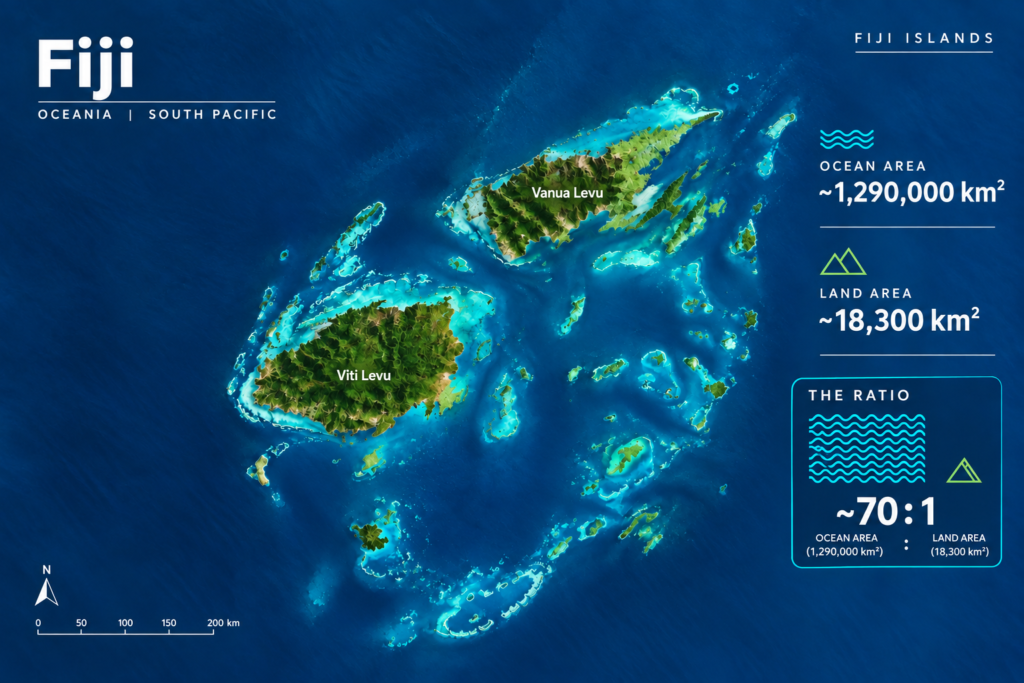 Fiji’s Ocean-to-Land Ratio: The Blue Economy. Author-generated (2026).
Why does it matter?
For Fiji, this isn’t an abstract environmental debate. Around 90% of the country’s population lives along the coast, while many communities depend directly on the ocean for food, income and transport.
That means a damaged reef isn’t simply an environmental problem. It can affect a fisher’s catch. A decline in fish populations can affect food security. A degraded coastline can make communities more vulnerable to storms. And a less healthy marine environment can make Fiji less attractive to the visitors on whom much of its economy depends.
The Blue Economy tries to connect those dots.
Instead of asking whether Fiji should choose between economic growth and environmental protection, it asks whether the two can be made dependent on one another.
If the ocean is treated as an asset, then keeping it healthy becomes an economic necessity.
The bigger sustainability picture
Fiji’s Blue Economy raises a question that many coastal countries will increasingly have to confront: Can we build prosperity from the ocean without exhausting the thing that makes that prosperity possible?
There is no simple answer.
Fiji still faces pressures from overfishing, climate change, pollution and the growing demands of tourism and development. A framework can set ambitions, but turning those ambitions into reality depends on investment, enforcement and the involvement of the communities whose livelihoods are tied to the sea.
But there is something hopeful in the direction Fiji is taking.
For a country whose ocean is so much larger than its land, protecting the sea cannot be treated as a side project. It has to be part of the country’s economic future.
The Blue Economy is an attempt to make that relationship explicit: a healthy ocean is not simply something Fiji wants to leave behind for future generations. It is something the country needs to keep healthy if those future generations are going to thrive.
In Fiji, sustainability is beginning to look less like a question of choosing between the environment and the economy — and more like recognising that, for an island nation, the two have never really been separate.