
 Iceland: Turning CO₂ into Stone
What if we could take carbon dioxide out of the air and turn it into rock?
It sounds unlikely. Carbon dioxide is an invisible gas, constantly moving through the atmosphere. We associate it with cars, factories, power stations and the burning of fossil fuels. It is one of the main greenhouse gases responsible for climate change, and once it has been released, getting rid of it is not straightforward.
In Iceland, scientists have found a rather unusual way of dealing with it. They dissolve carbon dioxide in water and inject it deep underground, where it reacts with volcanic rock and eventually becomes a solid mineral.
In other words, they turn CO₂ into stone.
The technology is called Carbfix, and it works with something Iceland has in extraordinary quantities: volcanic rock (Carbfix, 2026a).
Iceland sits on the boundary between two tectonic plates and has been shaped by volcanic activity for millions of years. Much of the country is covered in basalt, a dark volcanic rock that happens to contain the minerals needed to react with carbon dioxide.
Carbfix has found a way to make that natural process happen far more quickly.
What is Carbifix?
The process begins with carbon dioxide that has been captured from an industrial source. Instead of compressing the gas and storing it underground, Carbfix mixes it with water.
That carbonated water is then pumped deep beneath the ground and into formations of basalt.
This is where the interesting part happens.
The dissolved carbon dioxide reacts with minerals in the rock. The carbon gradually forms new carbonate minerals, becoming a solid part of the rock itself. Rather than keeping CO₂ underground as a gas, the process changes it into a stable mineral.
The idea may sound new, but the chemistry is not. Rocks naturally absorb and mineralise carbon dioxide over very long periods of time. Carbfix is essentially speeding up a process that already happens in nature.
And it happens much faster than you might expect.
During early experiments at the Hellisheiði geothermal power plant in Iceland, researchers found that more than 95% of the injected CO₂ had mineralised within two years (Carbfix, 2026a) — a process that would naturally take thousands of years or more.
The carbon is not simply placed underground and left there in its original form. It becomes part of the rock around it. The water used to carry the CO₂ underground can continue through the water cycle, while the carbon stays behind in the minerals.
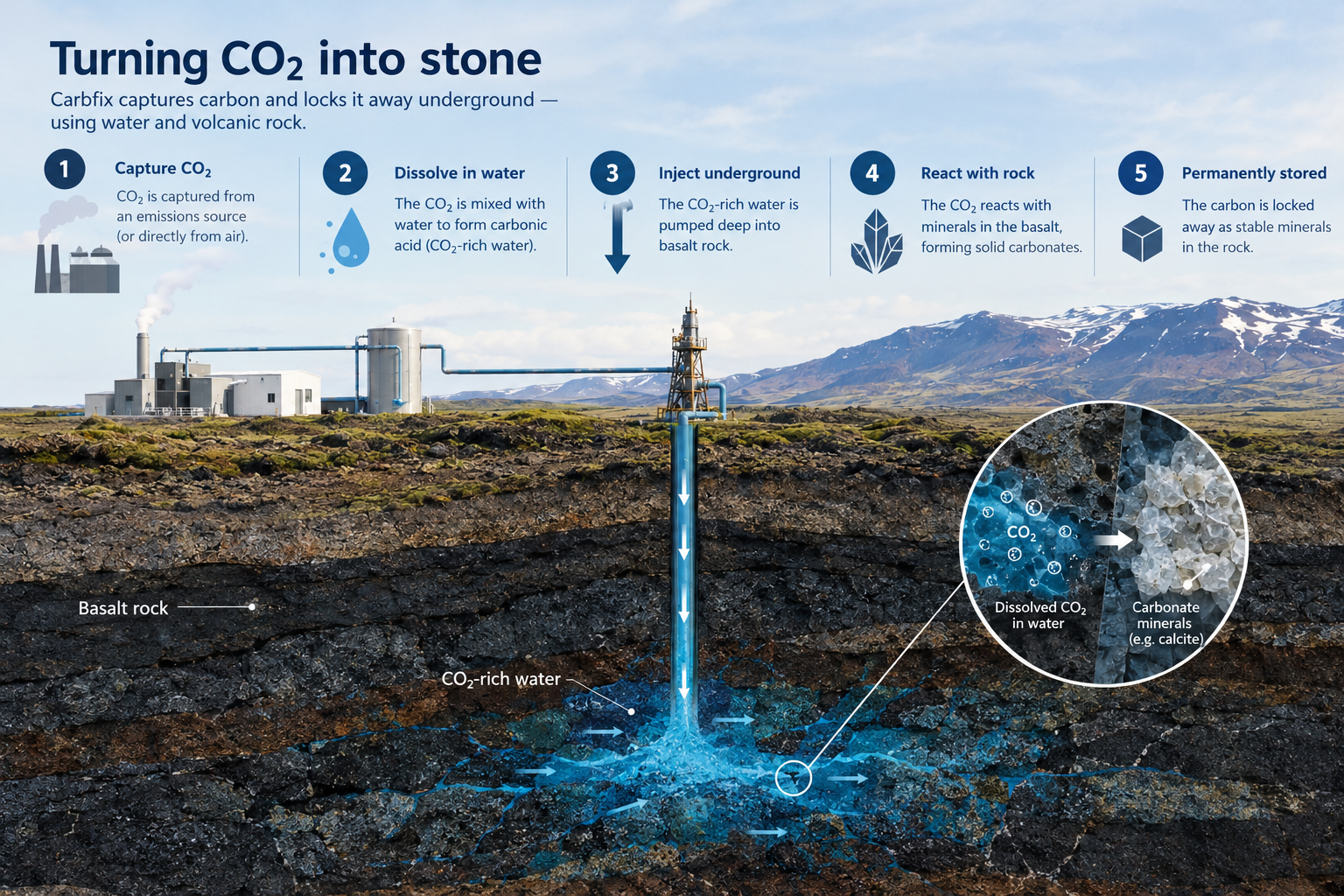 The process of turning CO₂ into stone through carbon mineralisation. Author-generated (2026).
Why does it matter?
There is a simple problem behind all of this: we cannot reduce every tonne of CO₂ to zero overnight.
Moving away from fossil fuels and towards cleaner energy is essential, but some industries are much harder to decarbonise than others. Cement production, steelmaking and other heavy industries can produce large amounts of CO₂, including emissions that come directly from the industrial process. Even with cleaner energy, some carbon will still be difficult to avoid.
That is where technologies such as Carbfix could have a role to play.
Rather than treating carbon capture as a way of carrying on as normal, the idea is to deal with emissions that cannot easily be eliminated. Capturing the carbon is only half the job; it then needs to be stored somewhere it cannot simply return to the atmosphere.
Iceland is particularly well suited to this approach. Its volcanic geology, combined with an established geothermal industry, provides both the underground conditions and infrastructure needed to develop carbon storage on a larger scale.
And the potential reaches beyond Iceland’s own emissions.
Carbfix is developing the Coda Terminal, which could allow captured CO₂ from industrial sites across Northern Europe to be transported to Iceland for permanent storage. The project is being designed to eventually handle millions of tonnes of CO₂ each year (Carbfix, 2026a).
For a country of fewer than 400,000 people, that is a surprisingly large role in a problem that stretches worldwide. Iceland’s volcanic landscape, which has shaped the country for thousands of years, could become part of how other countries deal with some of their hardest-to-remove emissions.
The bigger sustainability picture
Carbfix is impressive, but it is not a way around cutting emissions. Turning CO₂ into stone still requires energy, infrastructure and investment, and it cannot make the environmental cost of producing that carbon disappear.
Its value is in dealing with the emissions that are harder to avoid.
What makes the idea so striking is how ordinary the final ingredient is. Iceland is not relying on some rare material or completely artificial substance. It is using water, volcanic rock and a process that has been happening naturally for millions of years — only much faster.
The same volcanic forces that created Iceland’s landscape have provided the rock that can now help store some of the carbon produced by modern life, but it offers an unusual glimpse of what sustainability can sometimes look like: working with the natural world rather than trying to overcome it.
And somewhere beneath the Icelandic landscape, carbon that once floated through the atmosphere is becoming part of the rock itself.