
 Jamaica: Giving Old Refigerants a Second Life
Every day, we open the fridge without thinking about what makes it cold.
Behind the door, hidden from view, is a refrigerant — a substance that moves heat out of the fridge so that food stays cool. The same principle keeps air conditioners running in homes, shops and businesses across Jamaica.
But when these machines reach the end of their lives, the refrigerant inside them can become a problem. If it escapes into the atmosphere, some refrigerants can damage the ozone layer, while others are powerful greenhouse gases.
Jamaica is trying to change what happens to that gas.
In 2025, seven centres were established across the country to recover refrigerants from old refrigerators and air-conditioning systems, clean them and, where possible, put them back into use (Jamaica Information Service, 2025a).
It is a surprisingly simple idea: instead of letting the gas disappear, keep it in circulation.
What is Jamaica doing?
The idea forms part of Jamaica’s move towards a circular economy — an approach that aims to keep materials in use for longer instead of following the familiar pattern of taking resources, making products, using them and throwing them away.
Refrigerants are a good example of why this matters.
An old air conditioner may no longer be useful, but that does not necessarily mean everything inside it has reached the end of its useful life. The refrigerant can be removed before the equipment is dismantled, checked and processed so that it can potentially be used again.
Jamaica’s new centres are being set up across four parishes, providing places where this work can be carried out safely. They are also being used to train the people who will do it.
HEART/NSTA Trust is developing certification for technicians who recover and recycle refrigerants, with plans to train around 200 new people and upgrade the skills of at least 100 existing technicians over three years (Jamaica Information Service, 2026a).
That matters because a circular system needs more than somewhere to take old equipment. It needs people who know how to recover what is still useful, handle it safely and put it back into circulation.
Jamaica’s work with refrigerants also builds on years of progress in reducing the use of substances that harm the ozone layer. The country eliminated imports of chlorofluorocarbons (CFCs) in 2006 and had achieved a 96% phase-out of hydrochlorofluorocarbons (HCFCs) by 2026 (Jamaica Information Service, 2026b).
So the new centres are tackling a different part of the problem: what happens to the refrigerants that are already inside the equipment we use.
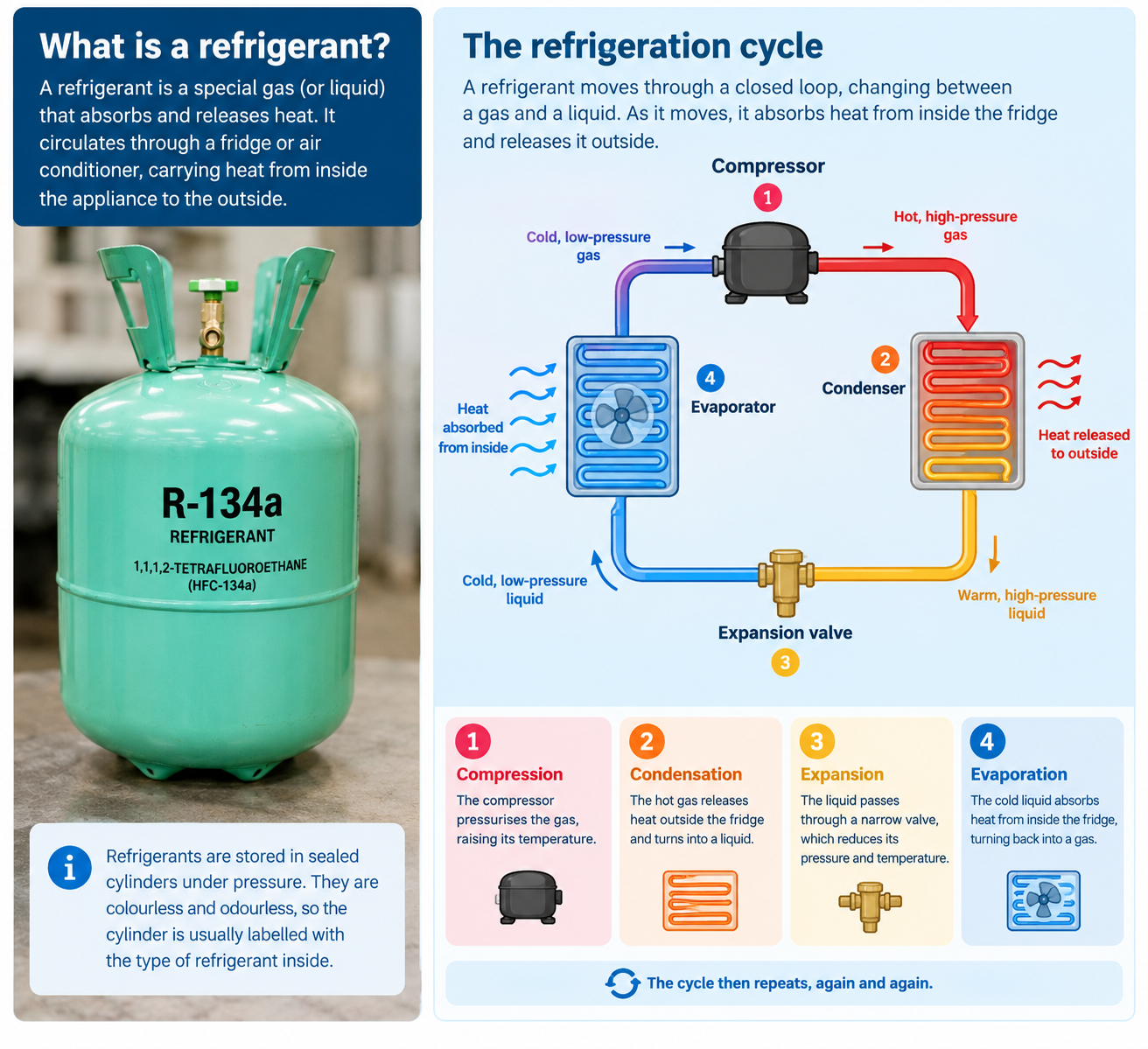 Diagram portraying refrigerants and the refrigeration cycle. Author-generated (2026).
Why does it matter?
Cooling is not a luxury in Jamaica. Refrigerators protect food and medicines, while air conditioning helps people cope with a hot climate. As temperatures rise, the need for cooling is only likely to become more important.
That makes the substances used to provide it worth paying attention to.
Older refrigerants such as CFCs and HCFCs have been phased out because of their effects on the ozone layer. Some of the alternatives introduced in their place have little or no effect on ozone but can still have a significant impact on the climate if they escape.
Recovering refrigerants means that a gas which is already in circulation does not automatically have to be replaced with newly produced or imported gas.
Jamaica imports much of its refrigerant, so recovering and reusing suitable material could reduce demand for new imports while creating work for technicians and businesses involved in the process.
It is a small shift in the way we think about an old appliance.
Instead of seeing the whole thing as something that has become useless, different parts can have different futures. The metal can be recovered. Components can be dismantled. And the refrigerant can be captured rather than released.
That is the circular economy in a very literal sense: keeping something in circulation instead of allowing it to become waste.
The bigger sustainability picture
Jamaica’s refrigerant programme sits within a wider effort to use resources more carefully. The country is also working to reduce single-use plastics, improve waste management and encourage businesses to use materials and resources more efficiently.
But the refrigerant centres offer perhaps the clearest example of what a circular economy can look like in practice.
There is no dramatic transformation to watch. No new material is being invented. Someone simply recovers a gas that would otherwise have been lost.
We tend to think of waste as something we can see: a plastic bottle, a discarded appliance, a pile of rubbish. But some of the materials with the greatest environmental consequences can be invisible.
Jamaica is building a system to make sure that when an old fridge stops cooling, its refrigerant does not simply disappear into the atmosphere with it.
Sometimes, sustainability is about looking at something we have always thrown away and realising that it was never really worthless in the first place.