
 Canada: Guardians of the Land
Who is watching over Canada’s wildest places?
Who notices when a landscape begins to change?
Sometimes, it isn’t a satellite orbiting hundreds of kilometres above the Earth. It isn’t a scientist arriving with a clipboard. Sometimes, it is someone who has spent years — even a lifetime — knowing that landscape closely enough to notice when something feels different.
Across Canada’s forests, coastlines, lakes and ice, Indigenous Guardians are doing exactly that.
Members of First Nations, Inuit and Métis communities, Canada’s three distinct Indigenous peoples, are monitoring wildlife, observing environmental changes and protecting places of cultural importance within their own territories.
There is something quietly powerful about this approach. Conservation is not being treated simply as something done to a landscape. It is being led by people whose lives, histories and communities are already deeply connected to it.
What has been implemented?
Canada’s Indigenous Guardians Initiative provides funding for community-led programmes, but there is no standard job description.
A Guardian might monitor wildlife, test water, record changes in habitats, observe activity on the land or protect culturally significant sites. In some communities, Guardians also work with Elders and younger generations, passing on traditional knowledge, language and stories connected to the territory, and there is some fascinating science behind what can seem like simple observation.
Take water temperature. A Guardian repeatedly measuring a stream may notice that it is becoming warmer over time. That matters because warmer water holds less dissolved oxygen, while fish and other aquatic organisms depend on that oxygen to survive.
One reading is just a number. A series of readings can reveal a trend, and a trend, combined with knowledge of the landscape, can start to tell a story about what is changing and why. That combination of scientific monitoring and Indigenous Knowledge is one of the most interesting aspects of the Guardians model.
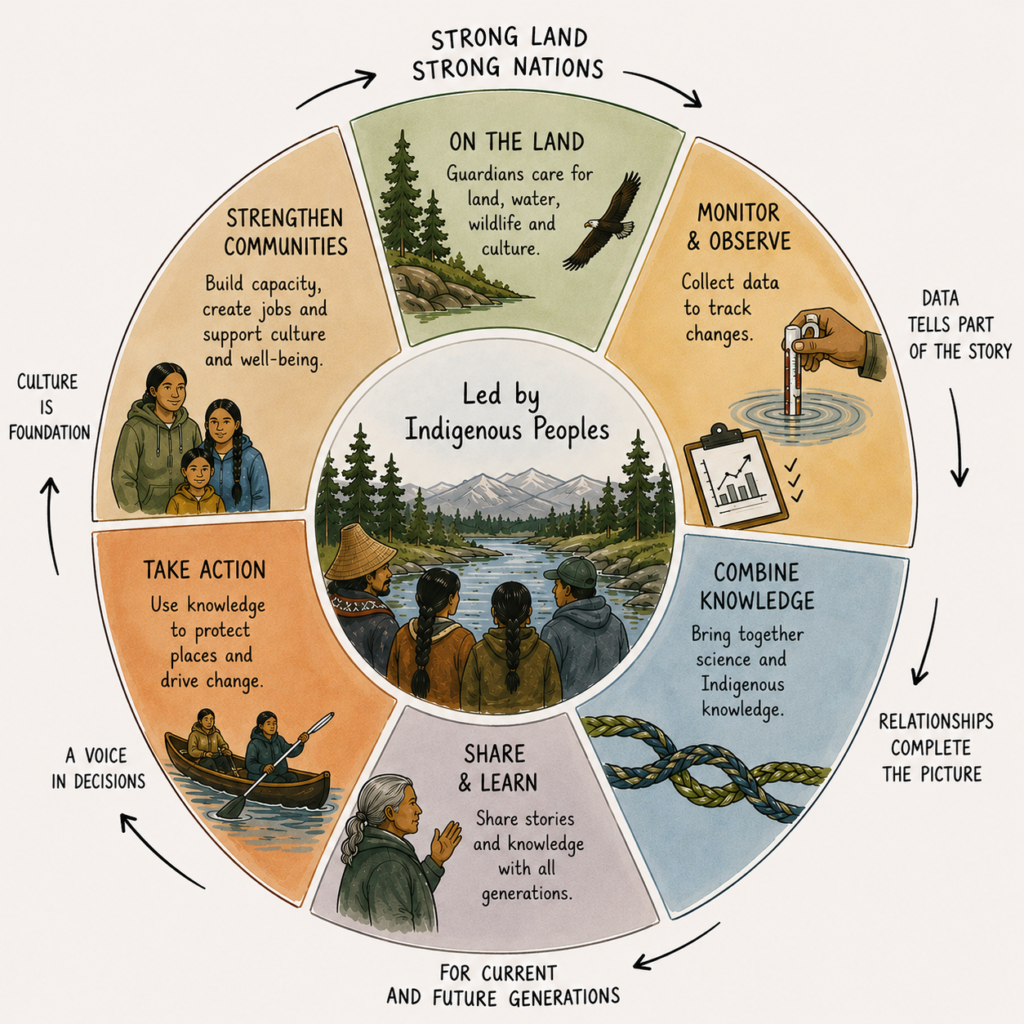 Indigenous Guardians model and the cycle of environmental stewardship. Author-generated (2026).
Why does it matter?
The scale of the programme says something important. Since 2018, more than 240 Indigenous Guardians initiatives have received federal funding, creating almost 1,500 culturally meaningful employment opportunities across Canada (Indigenous Leadership Initiative, 2024), but the numbers only tell part of the story. For someone living in a remote community, a Guardian role can mean meaningful work close to home, while also contributing to something much bigger than a job.
It can mean a young person spending time with an Elder, learning knowledge that has been passed down through generations, while staying connected to their language, culture and territory. At the same time, it gives communities a stronger voice in decisions about the lands and waters they depend on.
That is where the Guardians model becomes more than an environmental programme.
It connects conservation with culture, community and opportunity — protecting not just a landscape, but the relationship people have with it.
The bigger sustainability picture
The Indigenous Guardians model leaves us with a bigger question: who gets to decide how nature should be protected?
For generations, conservation has often been shaped by governments, scientists and organisations looking in from the outside. The Guardians approach shifts that balance, giving Indigenous communities greater resources and a stronger role in caring for their own territories.
There are still practical questions around long-term funding, decision-making and how different forms of knowledge can work together, but perhaps that tension is part of what makes the model so thought-provoking, because protecting nature may not always mean standing apart from it. Sometimes, it means trusting the people whose lives are already woven into the landscape — and giving them the opportunity to protect it.