
 Ecuador: The rights of nature
What if nature could have rights of its own?
Imagine a river standing before a court.
Not as evidence. Not as the property of a person or company, but as a legal subject — something whose existence, health and ability to continue its natural cycles are protected by law.
It sounds almost strange.
Yet in Ecuador, it is part of the constitution.
In 2008, Ecuador became the first country in the world to formally recognise the rights of nature, or Pacha Mama, in its constitution. Nature is given the right to exist, to maintain and regenerate its life cycles, structures and evolutionary processes. It also has a right to restoration when it has been damaged.
It represents a very different way of thinking about the natural world.
Rather than protecting a forest because humans need it, or a river because people depend on its water, Ecuador’s constitution gives nature something closer to a right to exist for its own sake.
What has been implemented?
The idea isn’t simply written into the constitution and left on a page. Ecuador’s courts have increasingly been asked to decide what these rights actually mean.
One of the clearest examples is Los Cedros, a protected forest in northern Ecuador where mining activity was proposed. In 2021, Ecuador’s Constitutional Court ruled that the forest’s rights had been violated and overturned environmental and water permits connected to the mining concessions. The Court emphasised that the rights of nature were legally enforceable — not merely an environmental ideal.
Other cases have pushed the idea further.
The Monjas River, which runs through Quito, was recognised by Ecuador’s Constitutional Court as a subject and holder of the rights granted to nature. The Court ordered measures aimed at restoring and protecting the river, and the principle extends beyond forests and rivers.
Ecuador’s Constitutional Court has recognised that animals are protected as subjects of rights through the rights of nature, while mangrove ecosystems have also been recognised as holders of those rights.
The law is therefore beginning to ask an unusual question: what does an ecosystem need, rather than simply what can humans take from it?
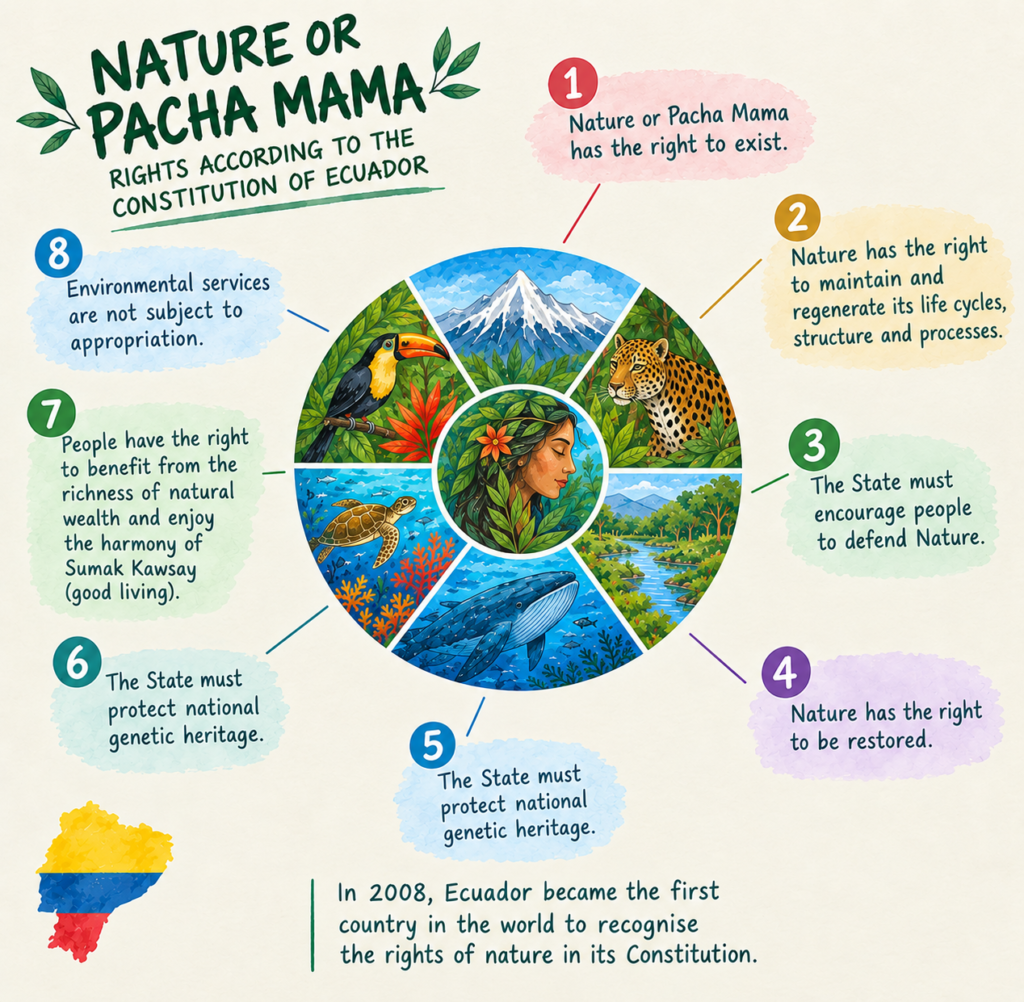 Nature or Pacha Mama: Rights According to the Constitution of Ecuador. Author-generated (2026).
Why does it matter?
For most of modern history, environmental law has largely worked by protecting nature because of its importance to people.
Clean water matters because we drink it. Forests matter because they store carbon, support wildlife and provide resources. Rivers matter because communities depend on them.
Ecuador’s approach turns that relationship around.
If a river can have rights, then damage to that river isn’t only a problem because it harms people. The river itself can be considered to have been harmed.
That shift can change the conversation around development. A mining project, road or other form of construction isn’t judged only by its economic benefits or its impact on human communities. The health and continued functioning of the ecosystem itself can become part of the legal argument.
It is a subtle change in language, but a profound change in perspective.
The bigger sustainability picture
Ecuador’s experiment ultimately asks a question that reaches far beyond its borders:
Who speaks for nature?
A forest cannot walk into a courtroom. A river cannot file a legal claim. An ecosystem cannot argue for its own survival.
So humans have to do it on its behalf.
That is where the idea becomes both powerful and complicated. Giving nature rights does not automatically stop oil extraction or large-scale project development. It creates a legal framework for challenging decisions that may damage ecosystems — but those rights still have to be interpreted, defended and enforced, thus creating some complexity.
What happens when economic interests meet the legal rights of a river? Can a forest’s right to exist outweigh the promise of jobs or investment? And who decides when the balance has tipped too far? These questions are no longer purely philosophical in Ecuador. They are being played out in courtrooms, communities and landscapes across the country.
Whether Ecuador’s approach will fundamentally change the way societies protect nature remains to be seen, but it has already done something remarkable: it has turned the idea of nature’s value into a question the law is required to answer.